The worst possible place for a flashback is right at the beginning of a story, but I see this on the regular from beginning authors. I know what’s usually going on here. Most of the time, these early, misplaced flashbacks are there to illustrate a character’s backstory, as if readers won’t care about or become invested in a character unless they know that character’s past.
But before readers will be interested in a character’s past, they need to be invested in the character’s present. They also need to feel grounded in time and place. Before you even think of diving into a flashback, you need to firmly establish the following:
• Where this story takes place
• What’s going on
• Who the main character is
• What immediate problem this person is dealing with
If you were watching a movie and a flashback began ten seconds into the film, you’d almost certainly think to yourself, WTF? I don’t even know what’s going on, and we’re already heading into the past?
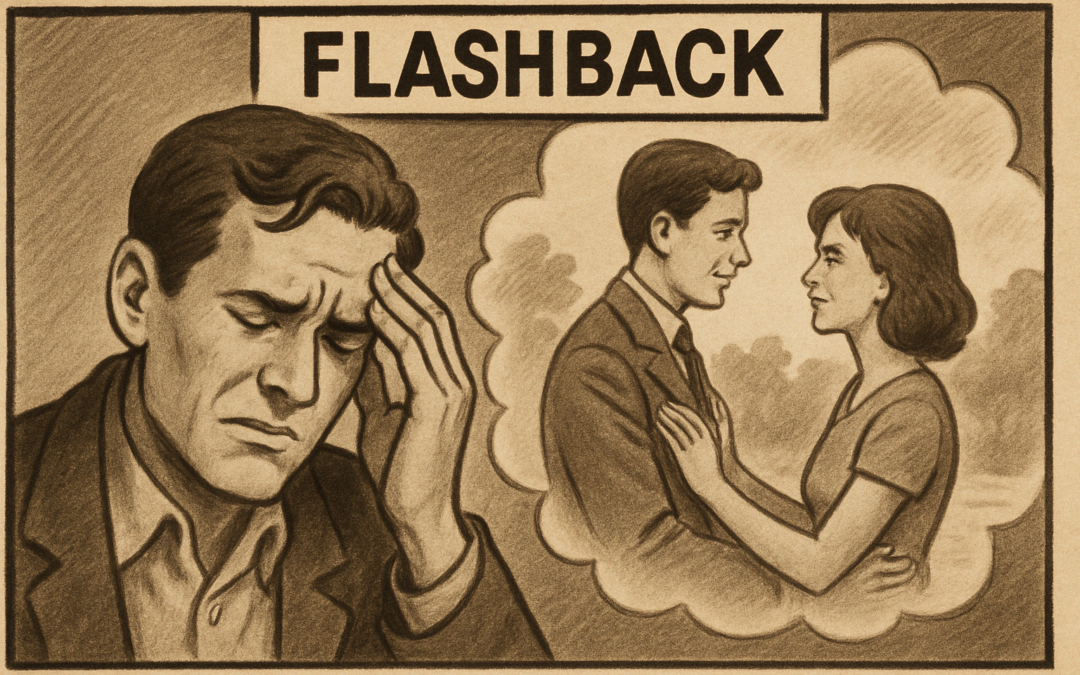
As detours to the past, flashbacks necessarily interrupt the main storyline. They’re often a character’s vivid memories triggered by something that’s happening in the present. They help readers better understand what’s going on in the character’s heart and mind now by briefly dramatizing something foundational in the character’s past.
Think of a flashback as additional, bonus information that’s dramatized rather than summarized. And since it’s additional, bonus information, you don’t want to start with it. Additional information comes later, not at the beginning.
Readers start out not knowing anything about your story world or your characters. Give them a minute to breathe and walk around and take in the sights. Let them get to know your characters by watching them interact with the story world and listening to them talk—not about mundane things like which breakfast cereal they need to get at the store or little Brittney’s swimming lessons but about something substantial, some problem, some drama, some disturbance in the rhythm of their ordinary lives. Give your story a chance to get going and your readers a chance to care about the outcome before yanking them out of the story and depositing them in some other place and time that they don’t know anything about and will care about even less.
If you insert a flashback early in your story, I can practically guarantee that nobody will want to read it. The same goes for overly long flashbacks that appear anywhere in your story. In a long flashback, you’re basically starting over with a whole new story, even if it includes the same character, and the longer you stay there, the more momentum the main story will lose.
If you want to start your story in the past before the main timeline, write a prologue. That’s what they’re for.
Whether you’re writing a flashback or a prologue, and no matter where you decide to insert it, don’t ever flash back to something that isn’t critically important. Ask yourself: Do I need to dramatize this? Can I summarize it instead? Can I just reference it with a sentence or two? Can I delete it entirely without consequence? Because the absolute last thing you should ever do with a flashback is take readers on a journey into an ordinary day in the past.If you want to include one or two flashbacks over the course of your book to dramatize a particularly compelling and crucial scene from your character’s past (when she saw her father murder a man, perhaps, or when the Russians invaded her Ukrainian village), that’s great, but never include ordinary scenes from the character’s childhood as a way to bring their backstory to life. If I’m a reader and have to choose between reading an info dump or an unnecessary flashback, I’ll sigh and choose the unnecessary flashback, but really, nobody wants to read either. As best you can, stick to the main timeline and reveal your character’s backstory in dribs and drabs over long periods of time.
Use flashbacks sparingly. Tell the vast majority of your story in chronological order. If you chop up your timeline with a whole bunch of flashbacks and whipsaw your readers back and forth between the present timeline and what happened a long time ago, you’re bound to lose most of them if you aren’t careful and don’t have an excellent and tactile grasp of story structure. I understand that you’ve seen this done well in successful novels and films. Christopher Nolan’s film Oppenheimer comes to mind, but Nolan is a genius, and in any case, I’m still not convinced that Oppenheimer wouldn’t be better if he told that story at least a little more chronologically than he did.
Some stories have dual timelines, with one taking place in the present and the other taking place in the past. Each timeline gets more or less equal time. Abandon by Blake Crouch is structured this way, for example, with one timeline taking place in the present and the other in 1893 in the same location. This is all fine and good, and stories structured this way can be particularly compelling. Just understand that scenes that take place in the past in a story that’s structured this way aren’t flashbacks. They’re complete scenes that take place on a second timeline.
No doubt you’ve seen timeline-hopping done well. What you probably haven’t seen is timeline-hopping done badly. I see it frequently in unpublished manuscripts. In my experience, beginning and intermediate authors who play around with this sort of thing create a narrative in the shape of a scrapheap instead of a story. It’s like they printed out their manuscript, dropped all three hundred pages onto the floor, then reassembled them in a random order. A confusing and unreadable mess, every time. Don’t do it. If you’re tempted to do it, resist. I recall a manuscript by a beginning author who ping-ponged back and forth between the present and the past multiple times per page. She didn’t even finish a scene before jumping back to the past, and then she abandoned that scene in the middle and jumped back to the present. After I told her that her book would work much better if she told the story in chronological order and completely finished a scene before starting a new one, she organized the scattered scene fragments, stitched them together, laid them out in chronological order, and improved the flow of her story dramatically.
Scenes are the building blocks of your book. And like your book as a whole, each scene has a beginning, middle, and end. If you shatter them by bebopping around the timeline without giving readers a chance to experience complete scenes, your structure will look less like a work of art and more like a box full of glass shards.
How to Write Flashbacks
There are two kinds of flashbacks: in-scene flashbacks and flashbacks that work as scenes unto themselves.
If your flashback is an entire scene unto itself, write it exactly the way you’d write a regular scene. As a brief refresher, here are the elements that every scene needs to include:
• A clear setting in a specific place and time
• A main point-of-view character
• A character goal and motivation
• At least one obstacle in the character’s way
• Dialogue between characters (unless your character is alone, but then she’ll probably have some dialogue with herself)
• Action
• Emotion
• Resolution
Flashbacks that take place in the middle of an ongoing scene tend to be shorter than regular scenes. They’re like little side trips into the past, and they usually aren’t complete scenes unto themselves. (If they are complete scenes unto themselves, wait until you’re finished writing your current scene before beginning the flashback.) You’ll need to indicate to readers when you begin one of these side trips so that no one is confused by the change of place and time. You can do so directly like this: “Janie was six years old and still living in Boston when her father killed a man right in front of her.” Or you can do it a little more subtly. Filmmakers do it by having one scene visually dissolve into another, by changing the color, by changing an actor’s appearance so they look younger, or by some other visual cue.
In writing, the best method is so subtle that most readers won’t even consciously notice that you’re using it, but it will work just as well as it would if they did notice. Call it the fade-in, fade-out method. If you’re writing in the simple past tense (he walked), briefly switch to the past-perfect tense (he had walked). This will tell readers that you’re describing something that happened earlier than whatever is going on in the main timeline. Then, once you’ve established that you’re in the past, switch back to the simple past tense throughout the bulk of the flashback. Nobody wants to read paragraph after paragraph of past-perfect narration. (He had walked to the store, and she had walked with him, and they had bought apples, and then they had walked back to the house.) All those hads will drive a human being crazy. When you’re just about finished with the flashback, a brief return to the past-perfect tense will indicate to readers that another time jump is coming (this time a return to the main timeline). And when you switch again to the simple past tense, we will have fully returned to the main timeline.
A flashback should feel organic and natural, like it belongs right where it is. Don’t just randomly flash back to the past for reasons that won’t be obvious to your readers. Include some kind of trigger. A character sees something or hears something, for instance, that sparks a memory. Or something that happened in the past directly bears on what’s happening right now in the main timeline. Janie saw her father kill a man when she was only six years old, and now her husband is pointing his own gun at someone, and it looks like he might pull the trigger.
Use Flashbacks Sparingly
Any time you begin a flashback, especially if you do it in the middle of an ongoing scene rather than as the start of its own scene, you’re slamming on the brakes and depositing readers somewhere and somewhen else, some place and time they weren’t thinking about and at least initially won’t care a fig about. They were happily reading along and wondering what’s going to happen next and then—bam!—they’re reading about something that happened thirty years ago.
They won’t care. Not at first anyway if you don’t seize them by the throat and refuse to let them go. So you need to make them care. And understand: It takes more effort and patience for readers to get through a flashback than it does to get through the next scene in the main timeline. You will pay a price for making them do this. It’s not a huge price necessarily, but you don’t get it for free.
You can justify this flashback and earn a return on your investment if the flashback is extremely compelling or reveals crucial information. But if you’re throwing in flashbacks all over the place (perhaps because you’re being “creative” or unconventional for its own sake or because you want to give your readers a sense of your main character’s past), you’re going to keep paying the flashback price without getting anything out of it.
Don’t Confuse Flashbacks with Flash-Forwards
A flashback is sometimes called an analepsis by literature geeks, and a flash-forward is sometimes called a prolepsis by the same geeks. Different things, different jobs.
Flash-forwards are increasingly common these days in both books and films, and those do tend to appear early in the story, usually right at the very beginning or at least at the beginning of a chapter. Their purpose is to hook the audience with a brief yet vivid scene, then back up in time to show the audience everything that led up to that moment. The opening shot in Netflix’s Ripley, for instance, based on Patricia Highsmith’s novel The Talented Mr. Ripley, begins with a man noisily dragging a corpse down the stairs in an apartment building. We hear a door opening and a woman’s voice crying out, “Who’s there?” The man dragging the body freezes in silence, waits for the door to close, and then resumes dragging the body. The entire scene only takes a couple of seconds, and it’s followed by text on the screen that reads “Six months earlier.” Not until several episodes later does the audience catch up to that scene in Rome where the main character, Tom Ripley, is dragging a body down the stairs. And by this time, we know exactly who he killed and why.
The scene where Ripley is dragging the body down the stairs is not the beginning of the story. Nor is everything that follows that scene a long flashback. Rather, the opening scene is a flash-forward. Flashbacks are brief detours into the past away from the main storyline. Flash-forwards are brief detours into the future away from the main storyline.
Scott William Carter’s Throwaway Jane begins with a one-paragraph flash-forward.
The girl jumped out of the back of a white Chevy Express at 9:47 p.m. I remember the time exactly because I was working the dinner shift at Sammy’s Barbecue, a hole-in-the-wall joint if there ever was one, and I always took my break at a quarter to ten. Or at least I had for the three months I’d been bussing tables. I also knew the time because that was what the gold Rolex I was staring at displayed the moment the van screeched around the corner into the back alley.
That’s the entire flash-forward right there. He then adds a few sentences to transition into the past, twenty minutes earlier that same night, which is the true beginning of the story. It reads like this:
Not my Rolex. It belonged to the drunken loser who’d just made the biggest mistake of his life—putting his big, sweaty arm around my neck in some kind of clumsy attempt to display his wild affection for me.
It was the last Sunday in September. Twenty minutes earlier, as I cleared the mess five frat boys from the University of Colorado had made for me while they watched the Broncos lose an overtime thriller to the Cowboys, Rolex Guy whispered his first sweet nothing to me.
With just a handful of sentences, he takes readers into the past, roughly twenty minutes before the story’s inciting incident when a young girl jumps out of the back of a moving van. Carter’s time jump appears right away, on page 1, and it works because it’s a flash-forward, not a flashback. He sets the scene perfectly. It’s not jarring or confusing at all. He gives readers everything they need to feel perfectly grounded in place, time, character, and situation. There is no WTF moment.
You know what would have created a WTF moment? If he’d set the scene in the bar for a paragraph or two and then flashed back to the main character’s childhood when she was having breakfast with her brother on a school morning.
Go ahead and open with a brief flash-forward if you want to. But once you make that initial time jump and begin narrating the events that lead up to the flash-forward, stay there. Don’t bounce around willy-nilly. With a mere handful of exceptions, narrate your scenes in chronological order, or readers will feel like you’ve fed your story into a food processing machine.
*
If you enjoyed this and learned something useful from it, you can read so much more in my book Write, Edit, Publish: What Every Writer Needs to Know but Only an Editor Will Tell You. You can also hire me as a developmental editor, line editor, copy editor, or publishing consultant. Tell me what you’re working on, send me your questions, ask for a free sample edit, or just say hi.